GC 기초와 G1GC - 동작 원리와 튜닝 손잡이

ep2~3에서 메모리가 “어떻게 잡히나”(Heap + Non-heap, buildpack이 -Xmx 계산)를 봤습니다. 이번 편은 그 Heap 안에서 GC가 메모리를 어떻게 회수하는지입니다. 그리고 이게 다음 편(업무 메모리/GC 이슈)의 토대가 됩니다.
TL;DR
- GC는 도달 가능성(reachability) 으로 live/garbage를 가른다: GC roots에서 닿으면 live, 아니면 회수 대상.
- weak generational 가설(“대부분 객체는 금방 죽는다”) -> Heap을 young/old로 나눔. young은 minor GC로 자주,낮은 비용으로 청소, 살아남으면 Old로 승격.
- G1(JDK9+ 기본)은 Heap을 같은 크기 region으로 쪼개고,
MaxGCPauseMillis(기본 200ms) 목표로 수거량을 조절하며, concurrent marking 후 mixed collection으로 Old를 정리한다.- marking 시작점 IHOP는 adaptive가 기본(초기 45%)이라, JDK 버전,부하에 따라 mixed GC 시작 시점이 달라진다.
1. GC와 도달 가능성(reachability)
1편에서 C는 free로 수동 해제, Java는 GC가 회수한다고 했습니다. GC의 판단 기준은 도달 가능성입니다.
1
2
3
4
5
GC Roots (스택 지역변수, static 필드, JNI 등)
   | 참조를 따라감
   v
도달 가능(reachable) = live (유지)
도달 불가능          = garbage (회수)
기본 아이디어는 mark(도달 가능한 것 표시) 후 회수입니다. (reachability/mark는 GC 일반 이론으로, 특정 구현/버전과 무관합니다.)
mark 이후 garbage를 어떻게 처리하느냐에 따라 회수 전략이 갈립니다. 고전적으로 세 가지가 있습니다.
- mark-sweep: live 객체를 표시한 뒤, 표시되지 않은 영역을 그대로 free list에 반환합니다. 객체를 옮기지 않아 빠르지만, 회수된 공간이 heap 곳곳에 흩어져 fragmentation(단편화) 이 쌓입니다. 큰 객체를 담을 연속 공간이 부족해질 수 있습니다.
mark-compact: mark 후 live 객체를 heap 한쪽으로 밀어 붙여(compaction) 빈 공간을 한 덩어리로 모읍니다. fragmentation을 해소하지만 객체 이동 비용이 듭니다. Oracle은 이 compaction을 회수 효율을 높이는 핵심 기법으로 명시합니다.
Try to recover larger contiguous free memory by compacting live objects.
- copying: heap을 둘로 나눠 live 객체만 반대편으로 복사하고 원래 영역은 통째로 비웁니다. 죽은 객체가 많을수록(=복사할 게 적을수록) 비용이 낮아, 곧 볼 young generation 수집에 잘 맞습니다.
이 세 가지는 뒤에서 볼 G1의 동작을 이해하는 토대입니다. G1은 young/old 모두 copying에 기반한 evacuation(live 객체 복사)으로 회수하면서 동시에 compaction 효과를 얻습니다.
2. Generational 가설: 대부분 객체는 금방 죽는다
핵심 관찰을 Oracle GC 튜닝 가이드는 이렇게 적습니다.
the weak generational hypothesis, which states that most objects survive for only a short period of time
Efficient collection is made possible by focusing on the fact that a majority of objects “die young.”
그래서 ep2에서 본 것처럼 Heap을 young/old로 나눕니다.
Minor GC는 Young만 copying으로 회수합니다. 대부분 객체가 Eden에서 죽기 때문에 자주 실행해도 Old 전체를 다루는 수집보다 비용이 작습니다.
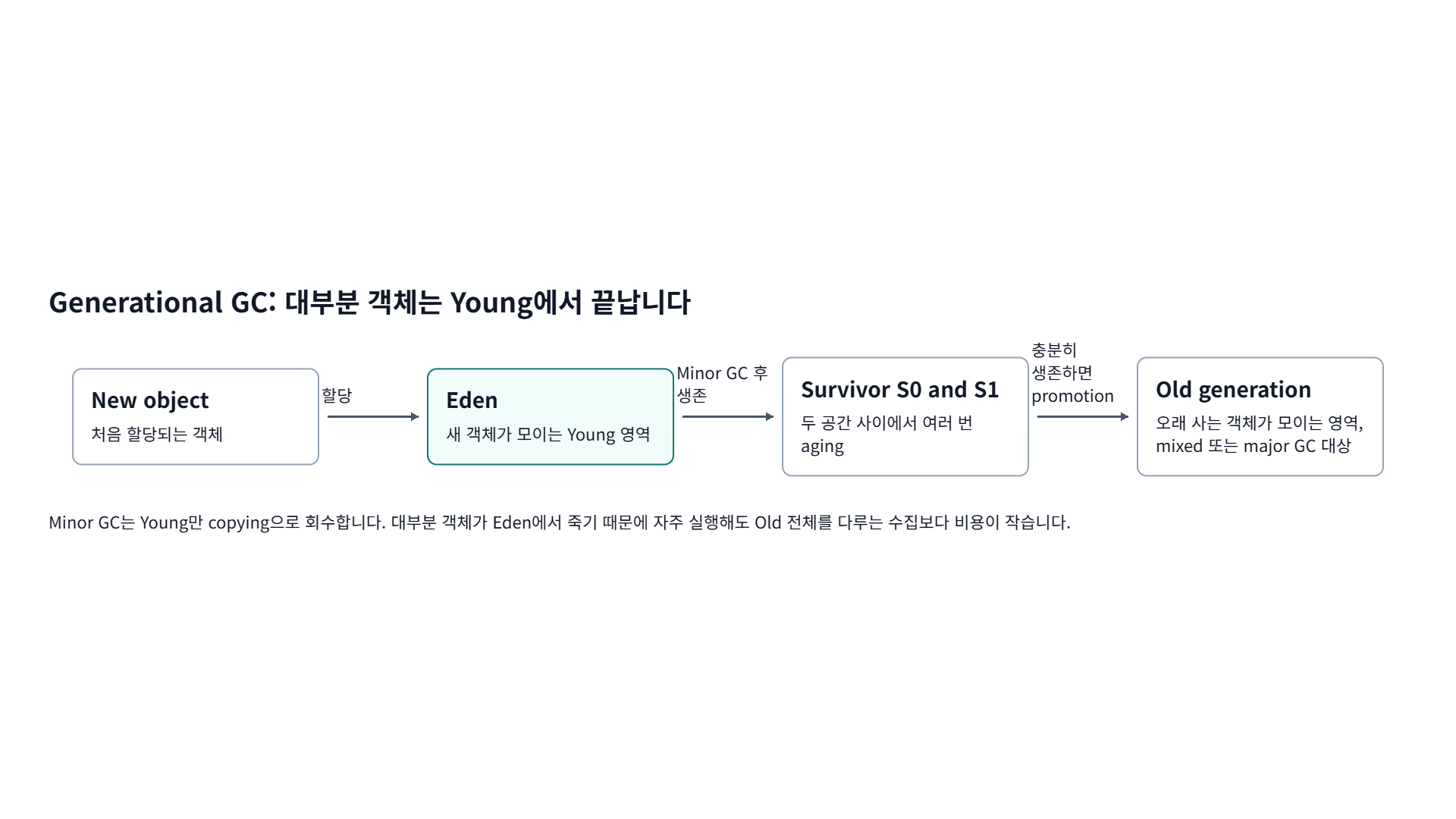
new object -> Eden -> (minor GC, aging) Survivor -> 승격 -> Old
The young generation consists of eden and two survivor spaces.
When the young generation fills up, it causes a minor collection in which only the young generation is collected … a young generation full of dead objects is collected very quickly.
즉 Minor GC는 young만 청소하므로, 대부분 객체가 거기서 죽는 한 자주 돌아도 비용이 낮습니다. 청소 방식은 위에서 본 copying입니다. 두 survivor space 중 하나는 항상 비어 있고, GC 때 eden과 사용 중인 survivor의 live 객체만 빈 survivor로 복사한 뒤 원래 영역을 통째로 비웁니다.
One survivor space is empty at any time, and serves as the destination of live objects in eden and the other survivor space during garbage collection; after garbage collection, eden and the source survivor space are empty.
이 복사를 반복하며 살아남은 객체는 일정 횟수 또는 공간 부족 시 Old로 옮겨집니다.
Objects are copied between survivor spaces in this way until they’ve been copied a certain number of times or there isn’t enough space left there. These objects are copied into the old region. This process is also called aging.
3. Major / Mixed GC, 그리고 STW
Old가 차오르면 Old를 청소해야 하는데, 전통적 generational에서는 major collection이 일어납니다.
Eventually, the old generation fills up and must be collected, resulting in a major collection, in which the entire heap is collected.
전통적 major는 “전체 heap을 한 번에” 청소합니다. 뒤에 볼 G1의 mixed collection은 young + 선택된 일부 Old region만 점진적으로 청소한다는 점이 다릅니다.
GC 중 일부 구간은 Stop-The-World(STW) 로, 앱 스레드를 잠깐 멈춥니다. 이 pause가 길어지면 지연(latency)에 직접 영향을 줍니다.
“금방 죽어야 할 객체가 Old로 잘못 승격(premature promotion)”되면 Old가 빨리 차고 무거운 Old 청소가 잦아집니다. young 공간이 부족하거나 객체가 너무 빨리 승격될 때 나타나는 전형적인 증상으로, 뒤에서 다룰 GC 이슈와 직접 연결됩니다.
4. G1GC: region 기반 + pause 목표
JDK 9+ 기본 수집기인 G1을 Oracle은 이렇게 정의합니다.
G1 is the default collector.
G1 is a generational, incremental, parallel, mostly concurrent, stop-the-world, and evacuating garbage collector
| E | E | S | O | O |
| O | E | H | O | E |
| S | O | E | E | O |
| O | H | O | S | E |
E: Eden, S: Survivor, O: Old, H: Humongous. 새 객체는 Eden, Young 생존 객체는 Survivor, 승격 객체는 Old에 배치됩니다. Humongous는 region 절반보다 큰 객체입니다.
세대는 연속된 주소 범위가 아니라 여러 region에 부여된 역할입니다. 한 시점의 region 역할은 GC 사이클에 따라 바뀔 수 있습니다.
G1은 selected region의 live 객체를 다른 region으로 복사해 evacuation과 compaction을 함께 수행합니다.
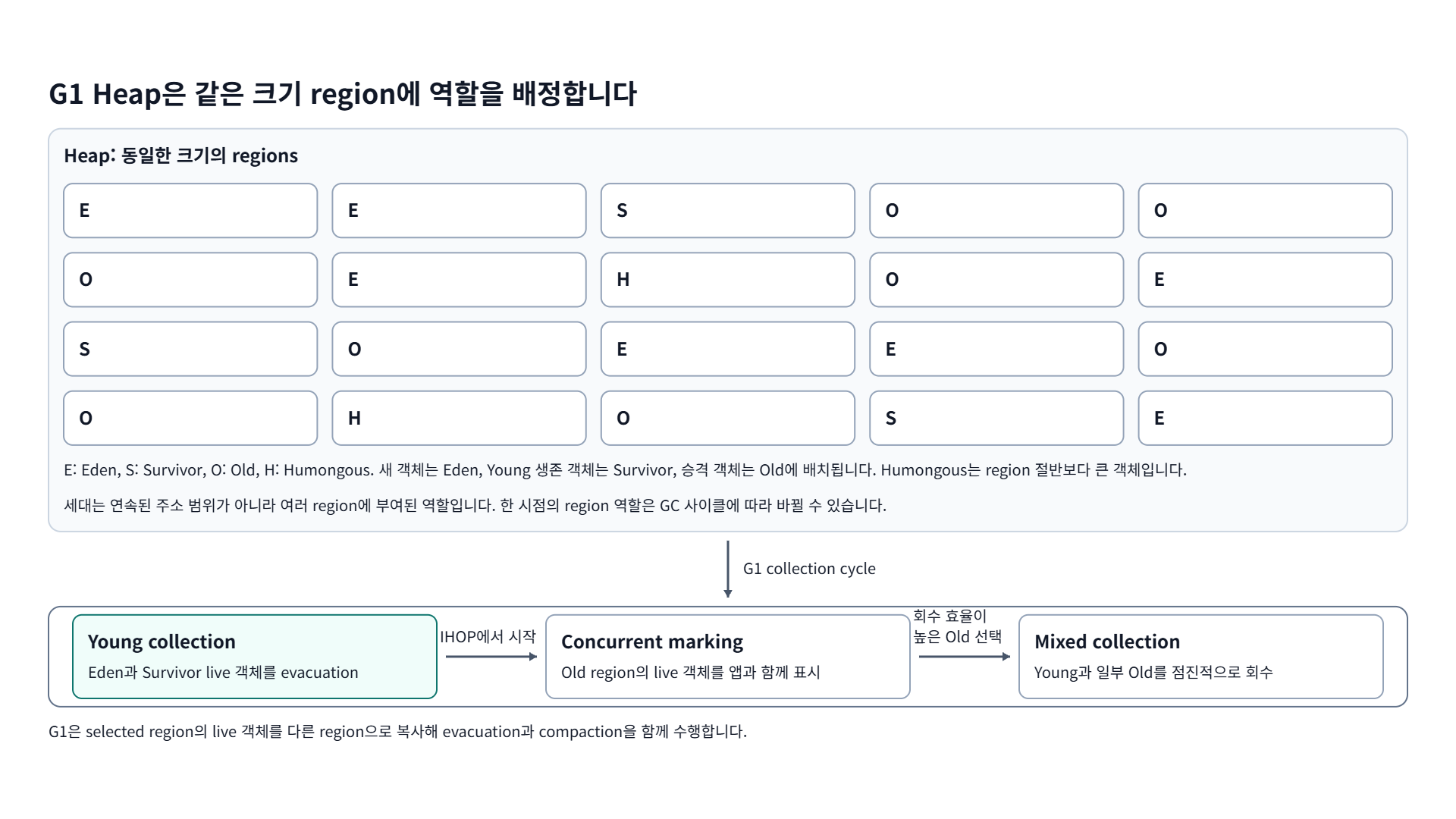
Heap = 같은 크기 region(E/S/O/H), 사이클: young -> concurrent mark(IHOP) -> mixed
핵심은 region입니다.
G1 partitions the heap into a set of equally sized heap regions … each of these regions can be empty, or assigned to a particular generation, young or old.
그리고 동작 3가지:
- Pause-time 목표:
-XX:MaxGCPauseMillis=200(“The goal for the maximum pause time”). G1은 이 목표 안에 끝낼 만큼만 수거하도록 young 크기를 동적으로 조절합니다. Concurrent Marking + IHOP: Old 점유율이 임계치(IHOP)를 넘으면 백그라운드로 Old의 live 객체를 표시합니다. 이때 G1은 SATB(Snapshot-At-The-Beginning) 마킹을 씁니다. 마킹 시작 시점의 heap을 가상 스냅샷으로 찍어, 그 시점에 live였던 객체는 이번 마킹이 끝날 때까지 live로 간주합니다. 마킹 도중 죽은 객체는 이번 사이클에서 회수되지 않고 다음으로 미뤄지지만(약간의 floating garbage), 그 대가로 마킹을 앱과 동시에 진행해 pause를 짧게 유지합니다.
G1 marking uses an algorithm called Snapshot-At-The-Beginning (SATB) . It takes a virtual snapshot of the heap at the time of the Initial Mark pause, when all objects that were live at the start of marking are considered live for the remainder of marking.
그리고 마킹을 트리거하는 임계치는 고정이 아닙니다.
-XX:+G1UseAdaptiveIHOPand-XX:InitiatingHeapOccupancyPercent=45… adaptive determination of that value is turned on, and that for the first few collection cycles G1 will use an occupancy of 45% of the old generation as mark start threshold.Mixed collection (evacuation pause): 마킹 후, young + 회수 효율 좋은 일부 Old region을 함께 수거합니다. G1의 회수는 STW pause 안에서 일어나는 evacuation입니다. 수거 대상(collection set)의 live 객체를 다른 region으로 복사하면서 그 과정에서 compaction까지 같이 이뤄집니다. 곧 앞 절의 copying + mark-compact가 region 단위로 결합된 형태입니다.
G1 reclaims space mostly by using evacuation: live objects found within selected memory areas to collect are copied into new memory areas, compacting them in the process.
… evacuate live objects of sets of old generation regions. These collections are also called Mixed collections.
객체를 옮기면 collection set 바깥에서 그 객체를 가리키던 참조도 새 위치로 갱신해야 합니다. 어느 region이 어디서 참조되는지를 매번 heap 전체 스캔으로 찾으면 너무 비싸기 때문에, G1은 region마다 remembered set(RSet) 을 두어 “이 region을 가리키는 바깥 위치”를 미리 추적합니다. evacuation 때는 이 RSet만 보면 갱신할 참조를 찾을 수 있어, Old 일부만 골라 수거하는 incremental 동작이 가능해집니다.
To evacuate the collection set G1 manages a remembered set: the set of locations outside the collection set that contain references into the collection set.
5. 다음 편(업무 이슈) 예고
핵심 손잡이를 정리하면: MaxGCPauseMillis가 young 크기를 좌우하고, adaptive IHOP가 mixed 시작 시점을 좌우하며, 그 사이에서 승격이 일어납니다. JDK 버전이 바뀌어 이 손잡이들의 균형이 달라지면 “Old가 천천히 차다가 mixed GC로 한 번에 뚝 떨어지는 톱니 패턴”이 나타납니다.
다음 편에서는 이 메커니즘으로 GC 튜닝과 JDK 17 -> 25에서의 G1 동작 변화(일반화된 사례)를 분석합니다.
DevSecOps 비유: GC pause는 짧은 stall, MaxGCPauseMillis는 수집기가 맞추려는 SLO, IHOP는 “Old가 이만큼 차면 청소 시작”하는 임계치(알람 threshold 같은)입니다.
6. 참고 자료
- Oracle GC Tuning Guide (SE 21) - Garbage Collector Implementation (generational / minor / 승격): https://docs.oracle.com/en/java/javase/21/gctuning/garbage-collector-implementation.html
- Oracle GC Tuning Guide (SE 21) - Garbage-First (G1) Garbage Collector (region / mixed / IHOP / pause 목표): https://docs.oracle.com/en/java/javase/21/gctuning/garbage-first-g1-garbage-collector1.html
궁금하신 점이나 추가해야 할 부분은 댓글이나 아래의 링크를 통해 문의해주세요.
Written with KKamJi